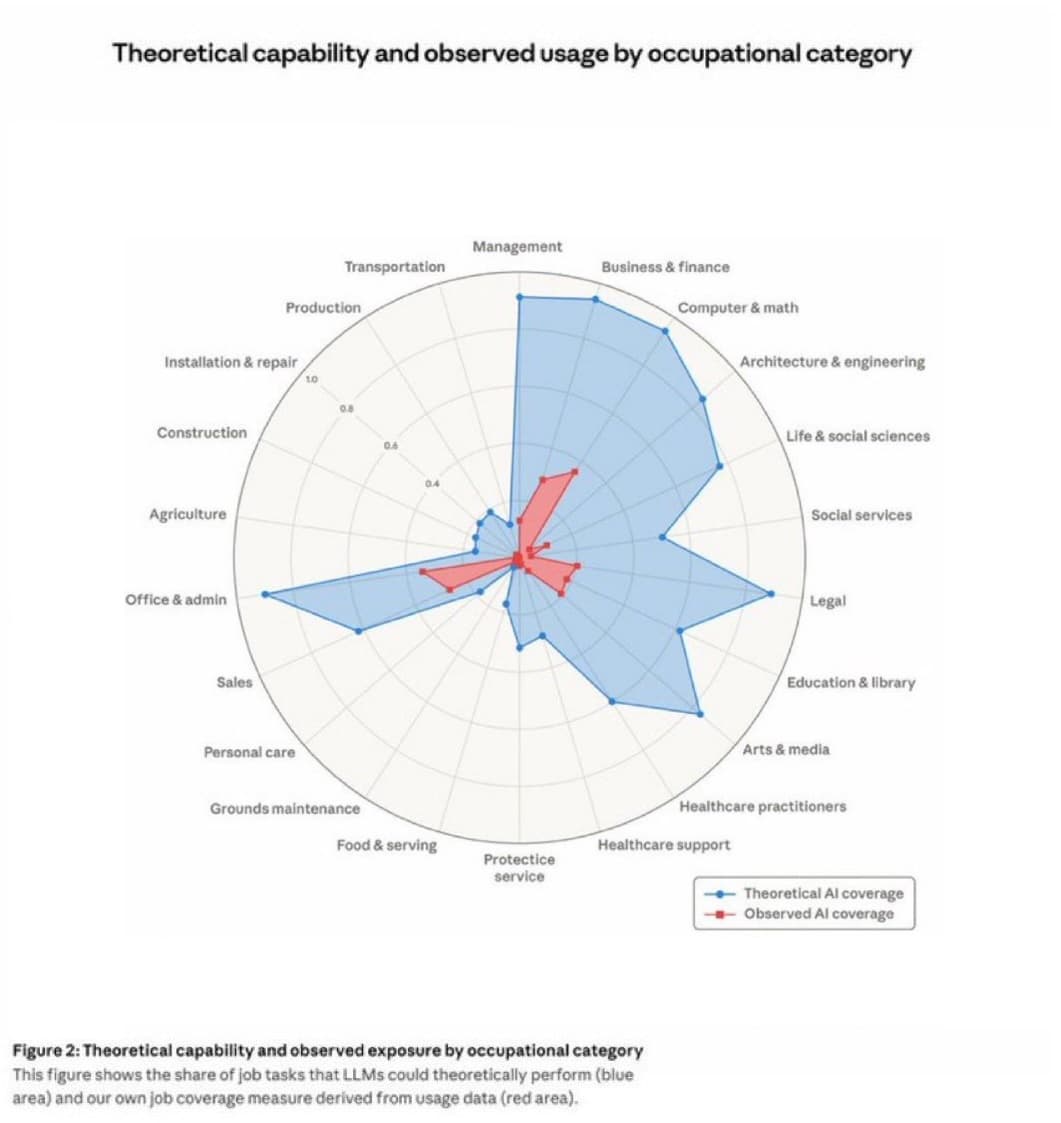
What the Chart Really Shows — AI Potential vs Real Usage
The radar chart highlights a big gap between what AI could do and what it is actually doing today. The large blue area represents the theoretical capability of AI — tasks AI could potentially perform across many industries. The smaller red area shows real-world usage based on how people are currently using AI tools. In simple terms: many jobs could be partially automated in theory, but most workplaces have not adopted AI at that level yet.
Jobs Already Entering the Red Zone
Some professions are already seeing significant AI usage. Jobs that involve routine text processing, data analysis, or repetitive digital tasks are the most exposed. This includes roles such as programmers, customer service representatives, data entry specialists, market research analysts, and some finance-related jobs. These roles rely heavily on information processing — something modern AI systems are becoming very good at.
Jobs That Are Still Relatively Safe
Not every job is at immediate risk. Roles that require physical work, human interaction, creativity, or real-world decision-making remain much harder for AI to replace. Examples include mechanics, healthcare workers, skilled trades, caregivers, chefs, and many service jobs. These roles depend on human judgment, empathy, or hands-on skills — areas where AI still struggles.
AI Will Change Work — But Slowly
Despite growing concern, the transition is gradual, not sudden. AI adoption is still developing and many companies are experimenting rather than fully replacing workers. Instead of eliminating entire professions overnight, AI is more likely to transform tasks within jobs, helping people work faster and more efficiently rather than replacing them completely.
How to Stay Ahead of the Red Zone
The best strategy is not to compete with AI, but to work alongside it. Learn how to use AI tools to improve productivity and automate repetitive tasks. Focus on developing uniquely human skills such as critical thinking, creativity, communication, and leadership. Another option is moving toward careers that build, manage, or secure AI systems, such as data science, cloud computing, and cybersecurity.